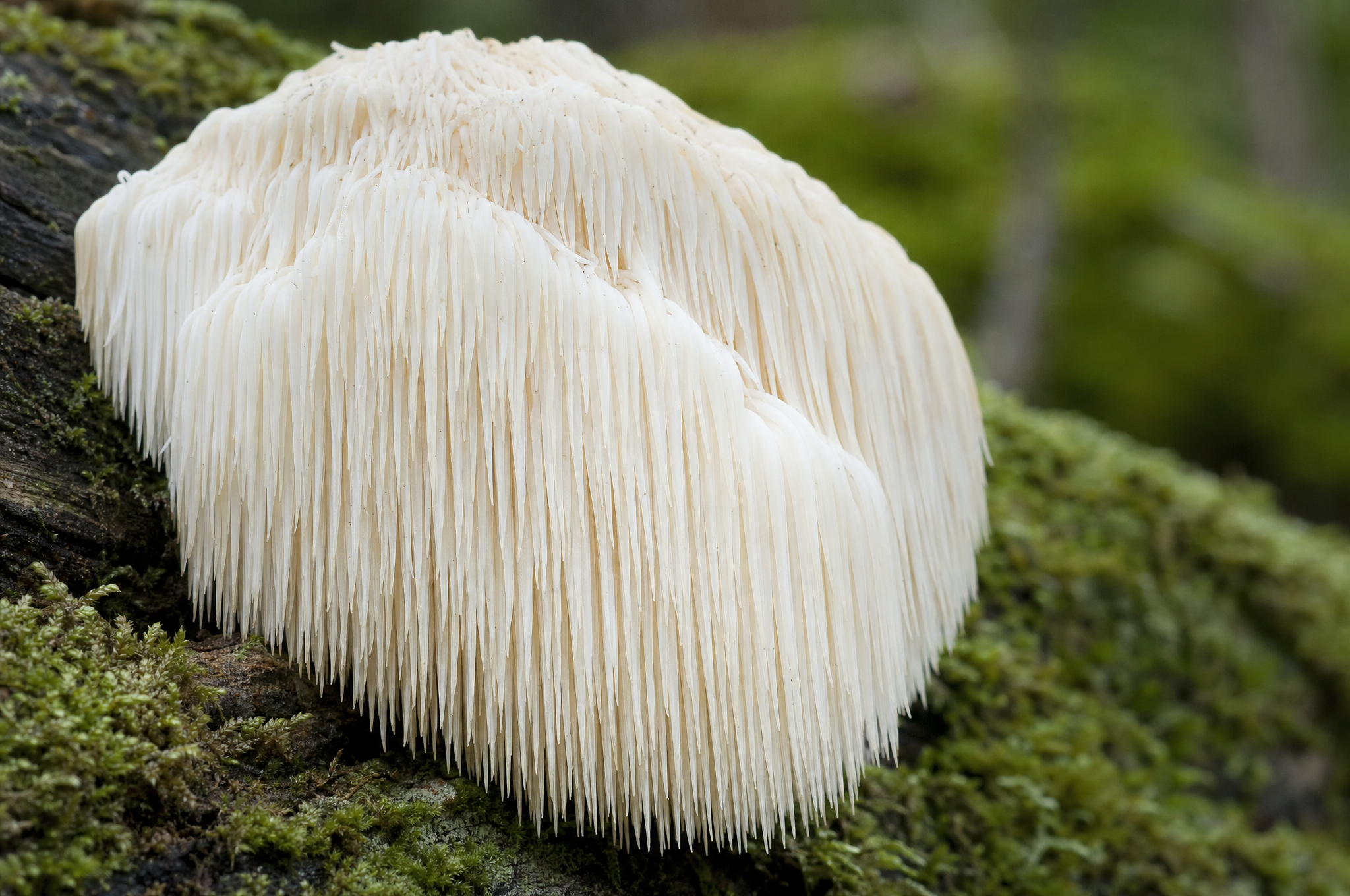
Start with a search for "Lion's Mane brain" and you'll quickly find claims that this mushroom regenerates nerves, reverses dementia, and boosts cognitive function. These claims are not fabricated — they originate from real scientific research. But they are also, almost without exception, extrapolated far beyond what the evidence supports. Let's look at what the studies actually found.
Two Compounds, Two Sources
The neurotrophic interest in Lion's Mane centers on two families of compounds, each found in a different part of the mushroom:
- Hericenones — isolated from the fruiting body (the visible mushroom with the cascading spines)
- Erinacines — isolated from the mycelium (the underground vegetative network)
Both compound families have demonstrated the ability to stimulate nerve growth factor (NGF) synthesis in cultured cells. NGF is a protein essential for the growth, maintenance, and survival of neurons. The discovery that a mushroom produces compounds capable of stimulating NGF was genuinely exciting to neuroscientists — and it launched a wave of research that continues today.
Because hericenones come from the fruiting body and erinacines from the mycelium, the specific part of the mushroom used in a preparation matters. A supplement made from mycelium will contain erinacines; one made from fruiting body will contain hericenones. Some products combine both. For more on this, see our guide to reading supplement labels.
What In Vitro Studies Show
In laboratory cell cultures, both hericenones and erinacines have been shown to:
- Stimulate NGF production in astrocytes (support cells of the nervous system)
- Promote neurite outgrowth — the extension of neuronal projections — in cultured cells
- Cross the blood-brain barrier in animal models (demonstrated for some erinacines)
These findings are robust and reproducible. But in vitro results are the starting point of pharmaceutical research, not the endpoint. Many compounds that show neurotrophic activity in cell cultures fail to produce meaningful effects in living organisms — often because of bioavailability, metabolism, or dose limitations.
Animal Studies: Promising but Preliminary
Several animal studies have explored Lion's Mane effects on cognitive function:
- Morris water maze studies: Aged mice fed Lion's Mane extract showed improved performance in spatial memory tasks compared to controls. These results are suggestive but involve small sample sizes and mouse-specific biology.
- Neurogenesis: Some studies reported increased hippocampal neurogenesis in rodents given Lion's Mane extracts, though the mechanism and relevance to humans remain unclear.
- Peripheral nerve injury: A notable study found that rats given Lion's Mane extract recovered faster from crush injuries to the peroneal nerve, with larger axon regeneration compared to controls.
Animal data provides important signals but cannot be directly extrapolated to humans. Rodent neuropharmacology differs from human neuropharmacology in meaningful ways.
Human Clinical Trials: The Real Picture
Human trials on Lion's Mane and cognition are limited but not nonexistent. Here's what they show:
The Mori et al. Study (2009)
Perhaps the most cited human trial, conducted in Japan, gave 30 older adults with mild cognitive impairment (MCI) either Lion's Mane powder (3g/day) or a placebo for 16 weeks. The Lion's Mane group showed improvements on the cognitive function scale compared to placebo — but the effect disappeared four weeks after supplementation stopped, suggesting the benefit (if real) requires ongoing use.
Critically, this study had a small sample size, used a self-rated cognitive scale, and has not been definitively replicated at scale. It is a promising signal, not a proof.
The Menopause Study (2010)
A separate trial gave Lion's Mane cookies to menopausal women and found improvements in self-reported cognitive function, sleep, and mood. The use of "cookies" as a delivery method illustrates some of the methodological variety — and limitations — in this research area.
What's Missing
- Large, multi-center randomized controlled trials
- Long-term safety data for chronic supplementation
- Studies using standardized, characterized extracts with known hericenone/erinacine content
- Replication of the Mori study with larger cohorts
The Bioavailability Question
Even if hericenones and erinacines have neurotrophic potential, a fundamental question is whether enough of these compounds reach the brain when Lion's Mane is consumed orally. Digestion, metabolism, and blood-brain barrier penetration all affect bioavailability. Some erinacines have shown brain penetration in animal models, but human pharmacokinetic data is essentially nonexistent.
This is one reason why extraction method matters. Different preparation methods (hot water, alcohol, dual extraction) yield different compound profiles. See our article on extraction methods for details.
What the Evidence Does and Doesn't Support
| Claim | Evidence Status |
|---|---|
| Compounds in Lion's Mane stimulate NGF in cell cultures | Well-supported (in vitro) |
| Lion's Mane improves cognitive function in animals | Promising but preliminary (animal) |
| Lion's Mane improves cognition in humans with MCI | One small trial suggests possible benefit; replication needed |
| Lion's Mane reverses dementia or Alzheimer's | Not supported — no clinical evidence |
| Lion's Mane is safe for long-term use | Limited data; appears well-tolerated in short studies |
A Balanced Take
Lion's Mane is one of the more scientifically interesting functional mushrooms. The discovery of compounds that stimulate NGF synthesis is a legitimate pharmacological finding. But the gap between "interesting laboratory science" and "proven cognitive treatment" is enormous, and the current evidence does not support the most dramatic claims made in marketing materials.
If you are experiencing cognitive changes — memory issues, confusion, or other neurological symptoms — please consult a healthcare provider. Lion's Mane is not a substitute for medical evaluation and treatment.
Interested in growing your own? See our guide to Lion's Mane cultivation at home.