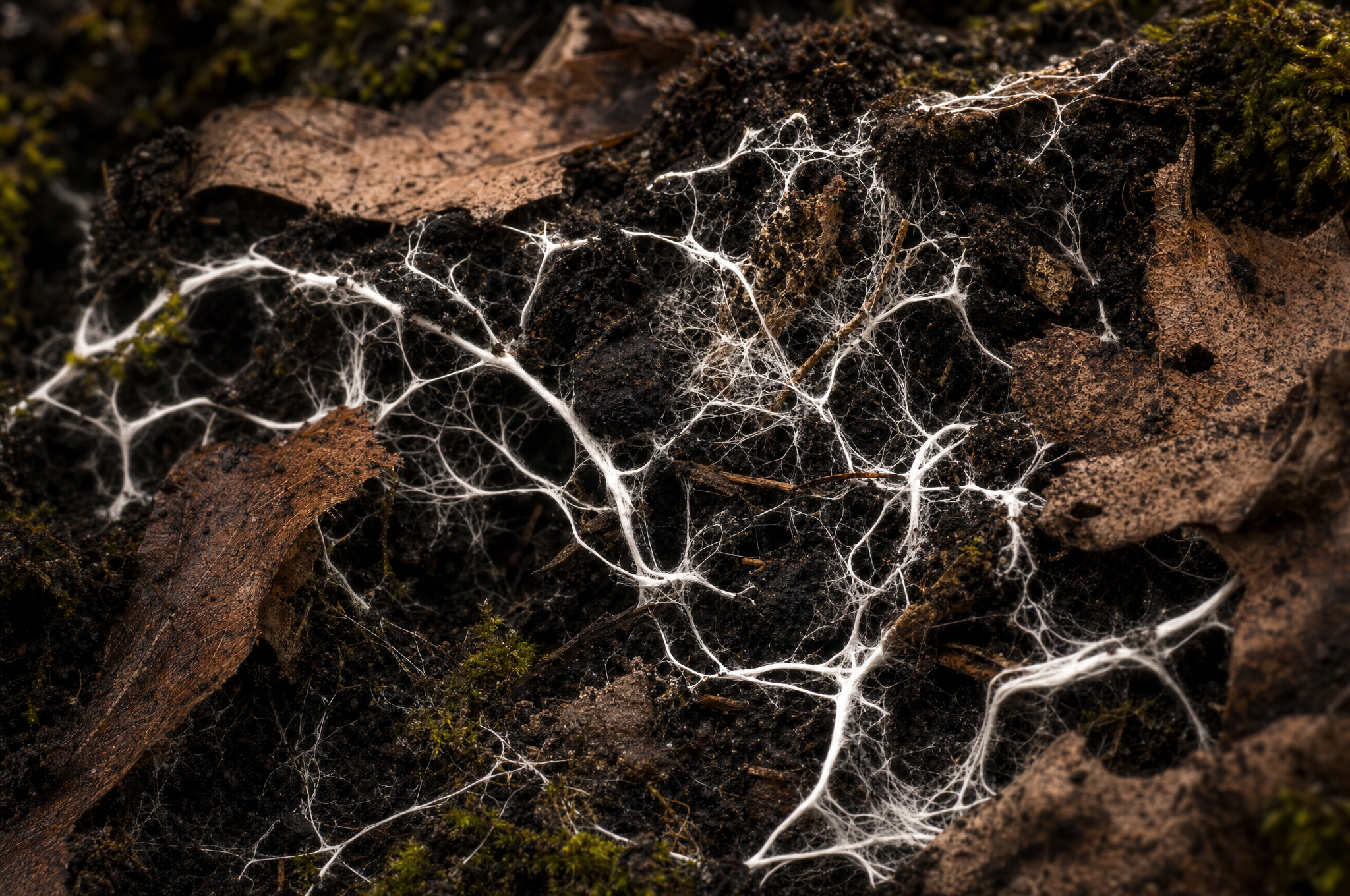
The mushroom you see above ground is not the organism. It is the fruit — a reproductive structure, like an apple on a tree. The actual organism is underground: a vast, branching network of threads called mycelium that can spread over acres, connect trees, and persist for centuries. This network has been called the "wood wide web," and it has transformed how we understand forest ecology.
But what does the science actually say? Can fungi "communicate"? Are they "intelligent"? Let's separate the rigorous findings from the poetic extrapolations.
What Mycelium Actually Is
Mycelium is the vegetative body of a fungus. It consists of branching, tubular cells called hyphae (singular: hypha). Each hypha is typically only a few micrometers wide but can grow to extraordinary lengths. A single teaspoon of healthy forest soil can contain kilometers of mycelial threads.
The mycelium is where the fungus does most of its living: absorbing nutrients, breaking down organic matter, and — in the case of mycorrhizal fungi — forming partnerships with plant roots. The visible mushroom is a brief, seasonal structure whose only job is to produce and disperse spores.
A single mycelial network of Armillaria ostoyae (honey fungus) in Oregon's Malheur National Forest covers an estimated 2,385 acres (965 hectares) and is thought to be 2,400–8,600 years old. It is one of the largest known organisms on Earth.
Types of Fungal Networks
Not all mycelial networks function the same way. Three categories are ecologically important:
Saprotrophic Fungi
These fungi decompose dead organic matter — fallen logs, leaf litter, dead roots. They are the primary recyclers of forest ecosystems, breaking down complex molecules like lignin and cellulose into nutrients that re-enter the soil. Without them, forests would suffocate under their own dead material.
Mycorrhizal Fungi
These fungi form symbiotic partnerships with plant roots. The mycelium extends outward from the root system, dramatically increasing the plant's access to water and minerals (particularly phosphorus and nitrogen). In exchange, the plant provides the fungus with sugars produced through photosynthesis.
Over 90% of land plants form mycorrhizal partnerships. This is not optional for most plants — it is how they survive. The network of mycorrhizal mycelium connecting multiple plants underground is the "common mycorrhizal network" (CMN) — the structure that earned the "wood wide web" nickname.
Parasitic Fungi
Some fungi derive nutrients from living organisms without providing benefit — though the line between symbiosis and parasitism can be blurry. Cordyceps, discussed in our Cordyceps article, is an example of an entomopathogenic (insect-parasitizing) fungus.
What "Communication" Actually Means
The claim that fungi "communicate" underground is partially true — but the word needs careful definition. This is not communication in the human or even animal sense. There is no intention, no language, no consciousness required.
What actually happens is chemical and physical signaling:
- Nutrient transfer: Mycorrhizal networks can transport carbon, nitrogen, phosphorus, and water between connected plants. Studies using radioactive and stable isotope tracers have demonstrated that nutrients can move from one plant to another through the fungal network.
- Chemical signaling: When a plant is attacked by pests or pathogens, it produces defensive chemicals. Some research suggests these stress signals can travel through the mycorrhizal network, triggering defensive responses in neighboring plants before they are attacked.
- Seedling support: Mature trees connected to the network can supply carbon to seedlings in the understory, which may otherwise lack sufficient light for photosynthesis. This has been termed "nursing" behavior.
These findings are well-documented in controlled experiments. The mycorrhizal network genuinely functions as a conduit for resource and signal exchange between plants.
The "wood wide web" is not a metaphor. It is a physical structure that mediates real ecological interactions. But it is also not a conscious, intentional system — it is biology operating without a mind.
Where the Claims Get Ahead of the Evidence
Popular science writing has sometimes extrapolated from the genuine findings to dramatic claims that outpace the evidence. Here are areas where the science is less settled:
- "Mother trees": The idea that certain large, old trees actively "manage" the forest through the network is a compelling narrative, but the evidence for intentional resource allocation is debated. Nutrient transfer can also occur from younger to older trees, not just the reverse.
- "Fungal intelligence": Some researchers have proposed that mycelial growth patterns demonstrate a form of problem-solving or intelligence. The slime mold Physarum polycephalum (not a true fungus) can find the shortest path through a maze, which is remarkable — but calling it "intelligence" stretches the term. These organisms respond to gradients and stimuli; whether that constitutes cognition is a philosophical question more than a scientific one.
- Universality: Not all forests have well-developed common mycorrhizal networks, and the nature of the network varies by ecosystem, fungal community, and disturbance history. The findings from one forest do not necessarily generalize to all.
Why This Matters Beyond Curiosity
Understanding mycorrhizal networks has practical implications:
- Forest management: Clear-cutting and soil disturbance destroy mycorrhizal networks, which can take decades to recover. Selective harvesting and retention of "legacy" trees may help preserve network continuity.
- Agriculture: Conventional farming practices (tilling, fungicides, synthetic fertilizers) can damage mycorrhizal associations. Reduced-till and organic systems may better preserve these beneficial partnerships.
- Restoration: Inoculating degraded soils with mycorrhizal fungi is an active area of restoration research, with mixed but promising results.
- Carbon sequestration: Mycorrhizal fungi store significant carbon in soil. Understanding how they respond to climate change is important for carbon cycle modeling.
The Wonder Without the Woo
You don't need to attribute consciousness to fungi to find the mycelial network extraordinary. The fact that a single fungal organism can span acres, live for millennia, connect entire forests, and mediate the exchange of nutrients between species is genuinely awe-inspiring. It is one of the most important ecological discoveries of the last several decades.
The science is still young. The tools for studying underground networks — isotope tracing, DNA sequencing, imaging — are improving rapidly. We will likely learn much more in the coming years. The best approach is to remain curious, follow the evidence, and resist the urge to make the network more (or less) than what it is.
Learn more about individual species in our Fungi Guide, or explore how mycelium is used in supplement production in our article on reading supplement labels.