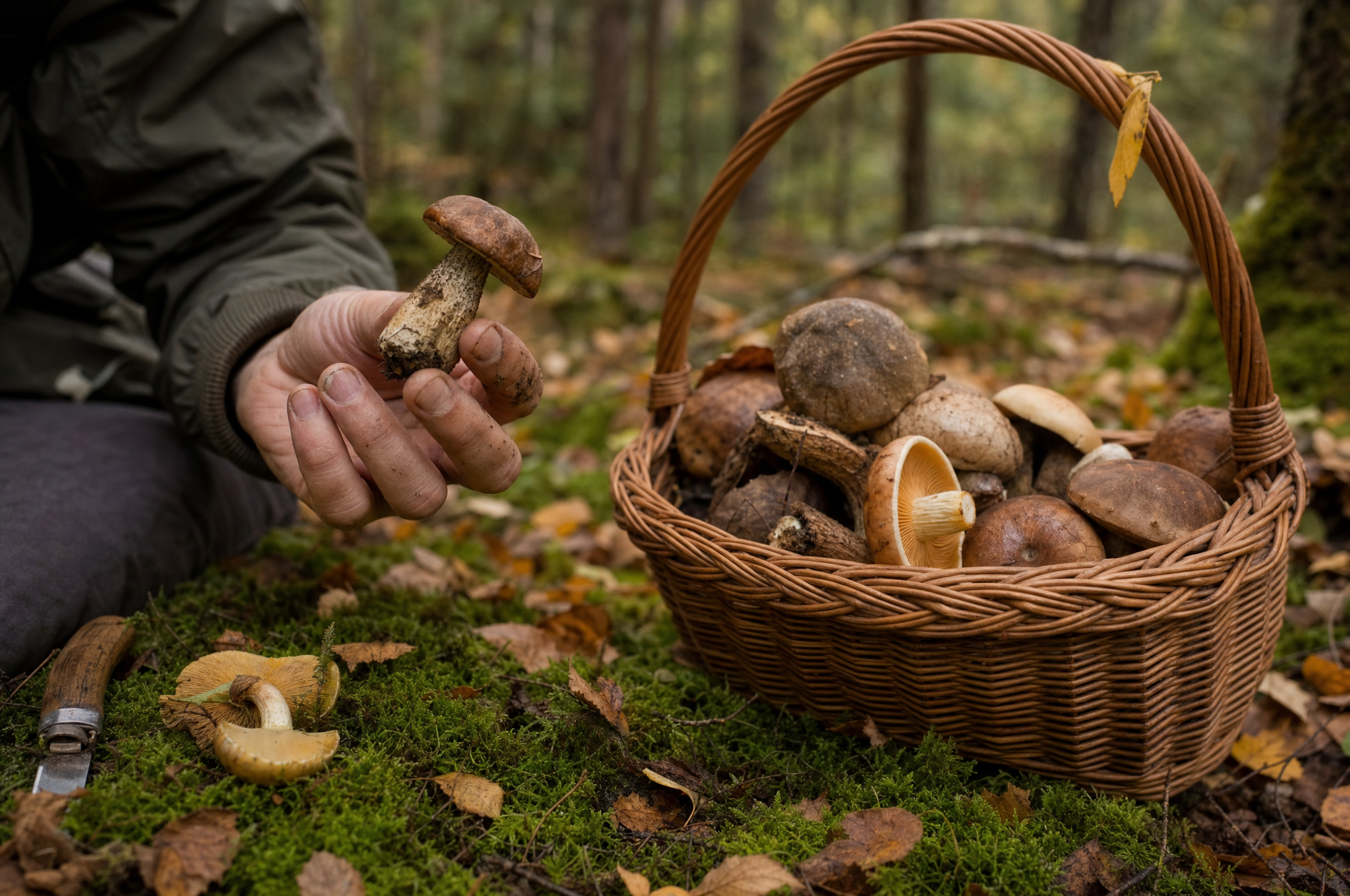
Most foraging writing focuses on safety: don't eat the wrong mushroom, learn to identify, start with easy species. These are essential. But there is another dimension that gets less attention — ethics. How we forage affects the fungi, the forest, the wildlife, and the foragers who come after us. Sustainable foraging is not just about protecting yourself. It is about protecting the ecosystem that makes foraging possible.
If you're new to foraging, read our beginner's safety framework first. Safety comes before ethics — but ethics should follow close behind.
Foraging regulations vary widely by location. National parks, state parks, and conservation areas often prohibit or restrict mushroom collection. Private land requires permission. Always research and respect local regulations before foraging anywhere.
Understanding What You're Picking From
The mushroom you see above ground is the fruiting body of a much larger organism — the mycelium network (discussed in our article on mycelial networks). Picking a mushroom is not like picking a flower from a plant. It is more like picking an apple from a tree: the organism survives, and will fruit again.
However, this doesn't mean picking has no impact. Repeated heavy harvesting can affect the fungus in several ways:
- Reduced spore dispersal: Every mushroom you pick is a mushroom that won't release spores. If enough fruiting bodies are removed before spore release, the fungus's ability to reproduce and spread may be affected over time.
- Energy cost: Fruiting requires significant energy from the mycelium. If a patch is harvested intensively year after year, the mycelium may have less energy to fruit in subsequent seasons.
- Trampling and habitat disturbance: The act of foraging — walking through habitat, moving logs, disturbing leaf litter — can damage the micro-environment fungi depend on.
The Cutting vs. Pulling Debate
One of the longest-running debates among foragers is whether to cut mushrooms at the base or pull them up from the ground. The argument for cutting is that it leaves the below-ground mycelium undisturbed. The argument for pulling is that some species can only be properly identified by examining the base (volva, basal bulb, and attachment).
The scientific evidence on this question is limited, but what exists suggests that neither method significantly affects the long-term productivity of a patch. A multi-year study in Switzerland found no difference in future fruiting between plots where mushrooms were cut and plots where they were pulled.
When identification requires seeing the base (as with Amanita species), pull the mushroom carefully and then replace the soil and leaf litter. When identification is clear from the cap and stem, cutting is fine. The more important question is not how you harvest, but how much you harvest and how you treat the habitat.
Principles of Sustainable Harvest
1. Take Only What You Will Use
The most fundamental ethical principle. Don't pick mushrooms to throw away later. If you're not certain you'll eat or study them, leave them. A mushroom left in the forest will release spores, feed wildlife, and decompose — all valuable functions. A mushroom picked and discarded has accomplished nothing.
2. Leave Mature Specimens
Older, fully mature mushrooms are the ones most likely to have already released spores. Younger specimens are still developing. When possible, leave some mature mushrooms to complete their reproductive cycle, and prefer mid-age specimens for eating — they tend to be better quality anyway.
3. Don't Strip a Patch
If you find a productive patch, resist the urge to take everything. A common guideline is to take no more than 25–50% of what you find in a given location. This leaves enough for spore dispersal, for wildlife, and for other foragers.
4. Minimize Habitat Disturbance
- Stay on trails where possible to avoid trampling
- Don't move logs and then leave them displaced — return them to their original position
- Replace leaf litter and soil after harvesting
- Avoid damaging the surrounding vegetation
- Don't create new paths through sensitive habitat
5. Don't Share Patch Locations
Among foragers, "spot burning" — publicly sharing the location of a productive foraging spot — is considered unethical. This is not selfishness; it is practical conservation. Popular spots get overharvested. Share locations only with trusted, responsible foragers, and always ask before sharing someone else's spot.
Respecting Wildlife
Mushrooms are food for many animals — squirrels, deer, slugs, insects, and others. When you take a mushroom, you may be removing a food source. This doesn't mean you shouldn't forage, but it's worth remembering that you are sharing the forest with other species.
Leave damaged or partially eaten mushrooms for the animals that are already using them. And if you encounter wildlife, give them space and priority — they live there; you are visiting.
The Commercial Foraging Problem
Personal foraging and commercial foraging are different in scale and impact. Commercial mushroom harvesting — where foragers collect large quantities for restaurants and markets — can have significant ecological effects:
- Intensive, repeated harvesting of the same areas
- Habitat damage from high foot traffic
- Pressure on slow-growing species (like chanterelles and matsutake)
- Economic dynamics that incentivize overharvesting
Some regions have implemented permit systems and harvest limits for commercial foraging. If you forage personally, you are unlikely to have a significant impact — but it's worth being aware that the commercial pressure on wild mushroom populations is real.
"The forest doesn't belong to us. We belong to the forest. Forage as a guest, not an owner."
Special Considerations for Rare and Threatened Species
Some mushrooms are rare or threatened due to habitat loss, overharvesting, or climate change. Examples include:
- Wild Cordyceps (Ophiocordyceps sinensis): As discussed in our Cordyceps comparison article, wild harvest has put pressure on this species. C. militaris cultivation provides a sustainable alternative.
- Matsutake (Tricholoma matsutake): Highly prized and commercially harvested, with declining populations in some regions.
- White truffle (Tuber magnatum): Extremely expensive and subject to intensive harvesting pressure.
If you encounter rare species, consider photographing rather than picking. Reporting rare finds to local mycological societies or conservation databases can contribute to scientific understanding without removing the specimen.
A Code for the Ethical Forager
Synthesizing these principles, here is a simple ethical code:
- Take only what you will use
- Never take more than half a patch
- Leave mature specimens for spore dispersal
- Minimize soil and habitat disturbance
- Respect private property and protected areas
- Don't share patch locations publicly
- Share knowledge generously, but not spots
- Pick up trash you encounter, even if it isn't yours
- Mentor new foragers in safety and ethics
- When in doubt, leave it in the ground
Foraging is a privilege, not a right. The forest doesn't owe us mushrooms. When we forage responsibly, we help ensure that the same forests will produce mushrooms for generations to come — for foragers, for wildlife, and for the fungi themselves.