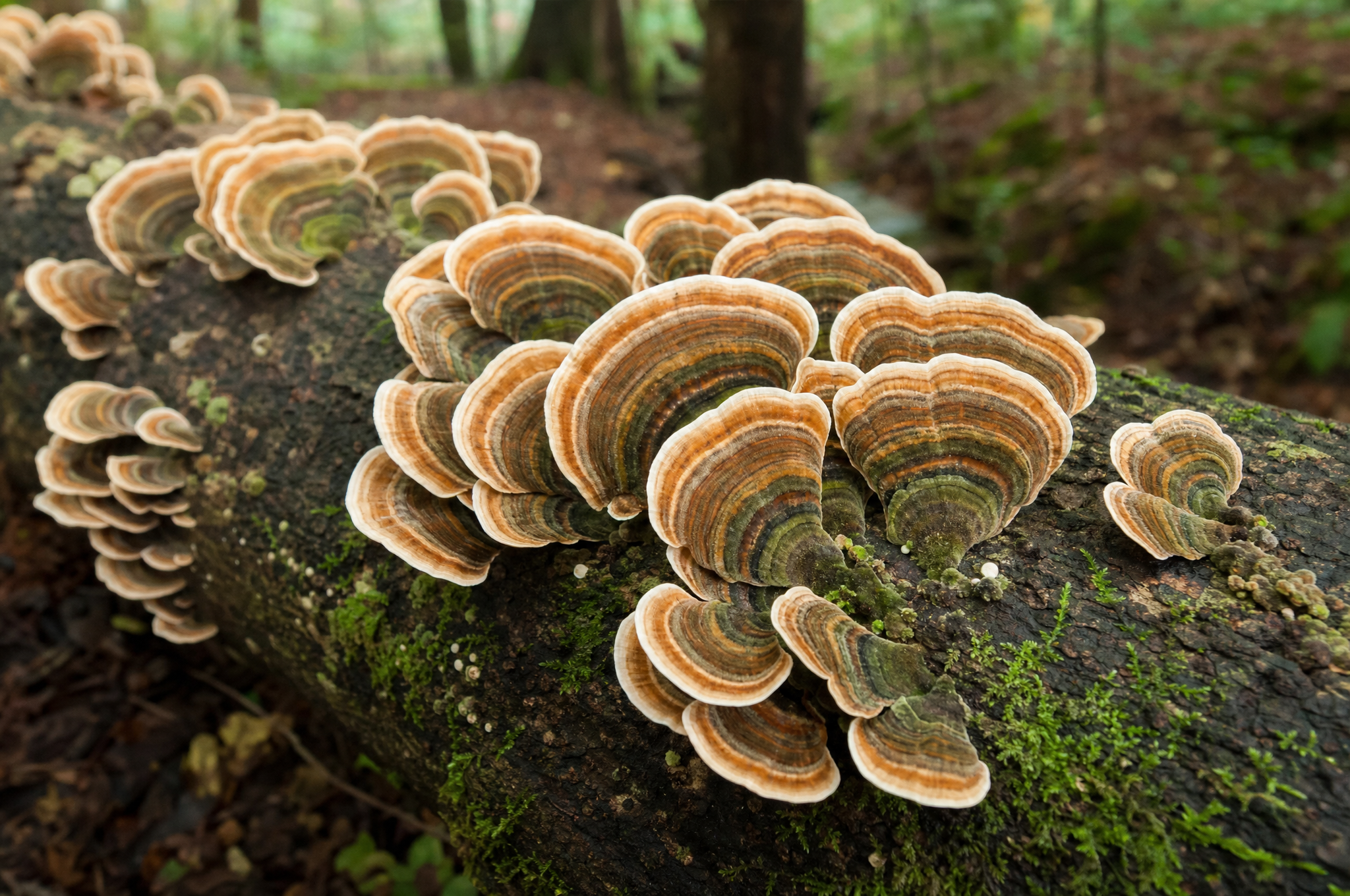
If there is a medicinal mushroom that has earned the right to be taken seriously by clinical science, it is Turkey Tail. While most functional mushrooms are supported primarily by in vitro and animal studies, Turkey Tail has something rare in this field: decades of human clinical research, including large trials, conducted primarily in Japan and China. Two compounds derived from it — PSK and PSP — have been used as prescription cancer adjuncts in Japan for over 30 years.
This doesn't mean Turkey Tail is a cancer cure. It isn't. But it does mean the evidence base is deeper than for most medicinal fungi, and the findings deserve careful attention.
The Species and Its Compounds
Turkey Tail (Trametes versicolor, formerly Coriolus versicolor) is a common bracket fungus found on dead and dying hardwood worldwide. It gets its name from the concentric rings of color — browns, rusts, creams, sages — that resemble a wild turkey's tail feathers. It is one of the most abundant mushrooms in temperate forests.
Two compounds derived from Turkey Tail mycelium have been the focus of clinical research:
| Compound | Full Name | Origin |
|---|---|---|
| PSK | Polysaccharide-K (Krestin) | Derived from Trametes versicolor mycelium (CM-101 strain), Japan |
| PSP | Polysaccharide-Peptide | Derived from Trametes versicolor mycelium (Cov-1 strain), China |
Both PSK and PSP are protein-bound polysaccharides — complex sugar molecules attached to protein. They belong to the broader category of beta-glucans, which are the primary immunologically active compounds in medicinal mushrooms.
PSK and PSP are specific, standardized pharmaceutical preparations derived from Turkey Tail mycelium. They are not the same as the Turkey Tail supplements sold in health food stores. Commercial supplements contain whole mushroom or crude extracts, which may or may not provide the same compounds at meaningful levels.
The Japanese Clinical Experience
PSK was approved as a prescription drug in Japan in 1977 and has been used there as an adjuvant (add-on) therapy in cancer treatment — primarily for patients who have undergone surgical resection of colorectal and gastric cancers. The rationale is that PSK may help support immune function after surgery and chemotherapy, potentially improving survival outcomes.
The evidence for PSK is more substantial than for most mushroom compounds:
- Multiple randomized controlled trials: Several RCTs in Japan have examined PSK as an adjuvant therapy in gastrointestinal cancers, with meta-analyses suggesting a modest survival benefit in certain populations.
- Thousands of patients: The cumulative clinical experience with PSK involves tens of thousands of patients, making it one of the most-studied mushroom-derived compounds in humans. Government approval: In Japan, PSK is covered by national health insurance for specific cancer indications — a level of regulatory recognition that no other mushroom compound has achieved in Western medicine.
However, it is crucial to understand what this evidence does and doesn't show:
- PSK is used as an adjunct to standard cancer treatment, not as a replacement for it
- Benefit is modest — not a cure, but potentially a small improvement in survival for some patients
- Most trials were conducted in specific cancer types (gastric, colorectal) in Japanese populations
- The quality of some older trials has been questioned by Western reviewers
- Results may not generalize to other cancer types or populations
The Science: How Beta-Glucans Affect Immunity
The immunological interest in Turkey Tail — and medicinal mushrooms generally — centers on beta-glucans. These are polysaccharides (complex sugars) with a specific beta-1,3/1,6-linked glucose structure that is recognized by the human immune system.
Here's how it works at a cellular level:
- Beta-glucans are recognized by receptors on immune cells, including Dectin-1, CR3, and TLRs (Toll-like receptors)
- This recognition activates immune cells, including macrophages, natural killer (NK) cells, and T-cells
- Activated immune cells may be more effective at detecting and responding to threats, including pathogens and abnormal cells
- This is why beta-glucans are described as "immunomodulatory" — they interact with and may enhance immune function
This mechanism is well-established in immunology. The question is whether it translates into meaningful clinical benefit — and for whom, at what dose, and in what form.
The NIH Breast Cancer Study
In the United States, the most notable clinical research on Turkey Tail has been conducted by researchers at the University of Minnesota and Bastyr University, with NIH (National Institutes of Health) funding:
- A Phase I dose-escalation study found that Turkey Tail extract was safe and well-tolerated in breast cancer patients after standard treatment
- Immune function measures (lymphocyte counts, NK cell activity) appeared to increase in a dose-dependent manner
- A follow-up study suggested that higher doses were associated with increased NK cell activity
These studies are promising but preliminary. They were small, focused on immune markers rather than clinical outcomes (survival, recurrence), and were not designed to demonstrate therapeutic benefit.
What the Evidence Supports
| Claim | Evidence Status |
|---|---|
| Turkey Tail beta-glucans interact with human immune cells | Well-established (mechanistic) |
| PSK as cancer adjunct improves survival in some GI cancers | Supported by Japanese RCTs; quality debated |
| Turkey Tail supplements boost immune markers in cancer patients | Promising but preliminary (small US trials) |
| Turkey Tail prevents or cures cancer | Not supported — no evidence |
| Turkey Tail supplements are equivalent to pharmaceutical PSK/PSP | Not established — different preparations |
The Supplement Reality
Here's the gap that marketing exploits: the clinical evidence is for PSK and PSP — specific, standardized pharmaceutical preparations. The Turkey Tail supplements available in health food stores are not PSK or PSP. They are crude hot water or dual extracts of the fruiting body (or sometimes mycelium on grain).
Whether these supplements provide the same immune benefits as pharmaceutical PSK is unknown. They may contain beta-glucans, but the concentration, specific structure, and bioactivity may differ significantly from the clinical preparations.
For more on how to evaluate what's actually in a mushroom supplement, see our guide to reading supplement labels. And for the science behind hot water extraction — which is how PSK and PSP are produced — see our article on extraction methods.
The Honest Assessment
Turkey Tail is one of the few medicinal mushrooms with substantial human clinical data. That data suggests a modest potential benefit as an adjuvant therapy in specific cancer contexts — not as a cure, not as a standalone treatment, but as a possible addition to standard care.
For the general consumer interested in immune support, the evidence is less clear. Turkey Tail supplements are likely safe, and they do contain beta-glucans that interact with the immune system. But whether they produce meaningful health benefits in healthy people is unproven.
If you are undergoing cancer treatment and considering Turkey Tail or any mushroom supplement, this is a conversation to have with your oncologist. Some supplements can interfere with treatment, and the quality of commercial products varies enormously. This is not a decision to make based on internet articles — including this one.